Long read · rust + ochre
A Business Modelled on Raga and Rhythm
What business might learn from structure and improvisation without reducing culture to branding.
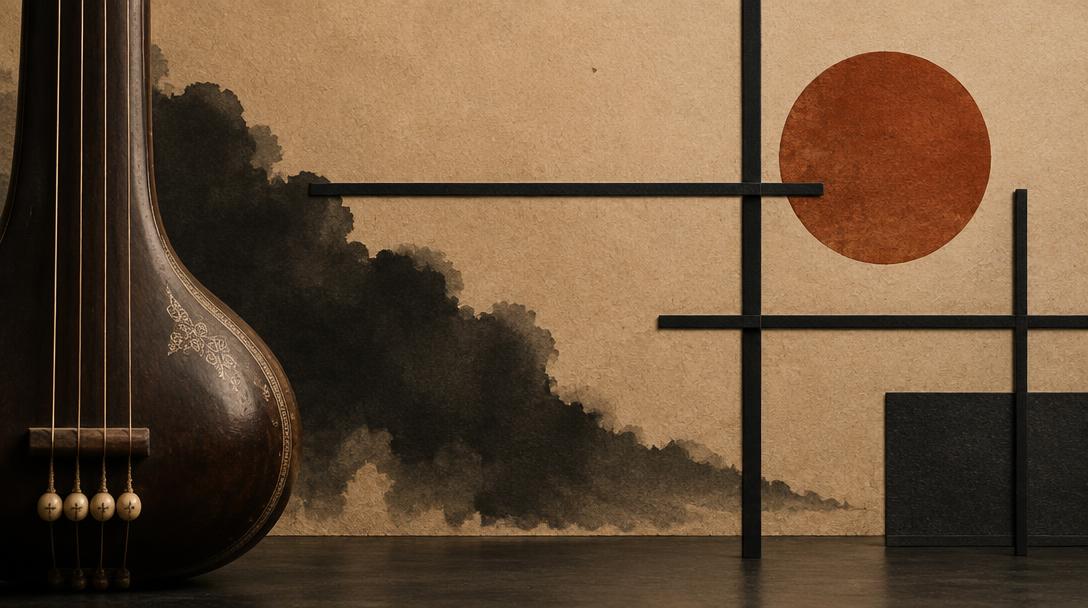
These responses improve S2W’s visual language across this project and approved S2W API surfaces. No visual is replaced or published automatically.
The real challenge in building anything for a market as complex as this subcontinent is finding a decision-making model that doesn't oversimplify it. Media and journalism, riding the digital wave, are pulling apart classical social systems faster than any replacement is arriving. Overhauling everything is not a plausible answer, and neither are timid half-measures. What's needed is change substantial enough to integrate without disrupting outright — and building that kind of change starts with studying, honestly, the models already being tried, so there's a real reference point for what actually works.
A culture this old and this diverse cannot be reduced to a simple idea and still expect that idea to survive contact with real implementation. A simple idea can capture the collective conscience easily enough — it can never be simple to actually execute at this scale, and that gap is a practical limitation, not a failure of intent. Performing arts have, for centuries, been one of this region's central mechanisms for working through exactly this kind of complexity: dance, theatre, music, and design have repeatedly given fresh breath to dying ideas, and just as often quietly ended movements that had lost their way. A framework inspired by the very culture it has to work inside of tends to make more intuitive sense than one imported wholesale from somewhere else.
Classical Hindustani and Carnatic music, for instance, have both survived the test of time by holding an unusually elegant balance between rigid structure and real fluidity — which is exactly the balance any sustainable business or institution is also chasing, whether it admits it or not. When business borrows this kind of framework only for its aesthetics, it produces branding. When it borrows the underlying discipline — the willingness to hold structure and improvisation at once, and to measure itself honestly against the culture it claims to represent — it starts to become something closer to a socially accountable way of building: rooted enough in where it comes from to be trusted by the people it serves, and disciplined enough in its own practice not to exploit that trust the moment growth gets hard. That, and not the packaging, is the actual differentiator worth building for.
Margin note
Borrowing the surface makes branding. Borrowing the discipline may change the model.
Source & provenance
ARCHIVE-DERIVED ORIGINAL
Edited from the author’s archive/source notebook.
- Provenance type
- original essay
- Confidence
- authored
Did the thought land?